Aktuellt om skogsskador och SLU Skogsskadecentrum | |
|
|
Insects threaten Europe's coniferous forests as the climate gets warmer
|
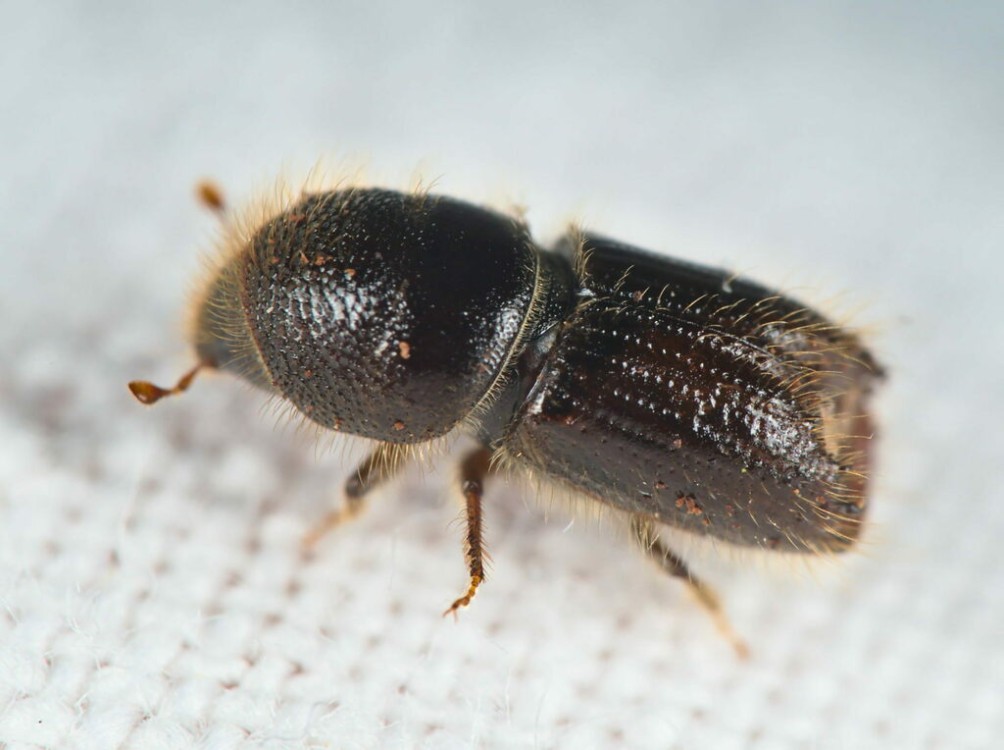
More and more trees in Europe are dying due to insect infestation. Conifers are the most severely affected, while deciduous trees seem to be coping better. Heat and drought are making the situation worse. This is shown by an international study led by the Czech University of Life Sciences with participation from the Swedish University of Agricultural Sciences (SLU).
Photo:
Gilles San Martin, Creative commons license BY-SA
|
| | New discovery: How spruce bark beetle infestations can be detected early from the air
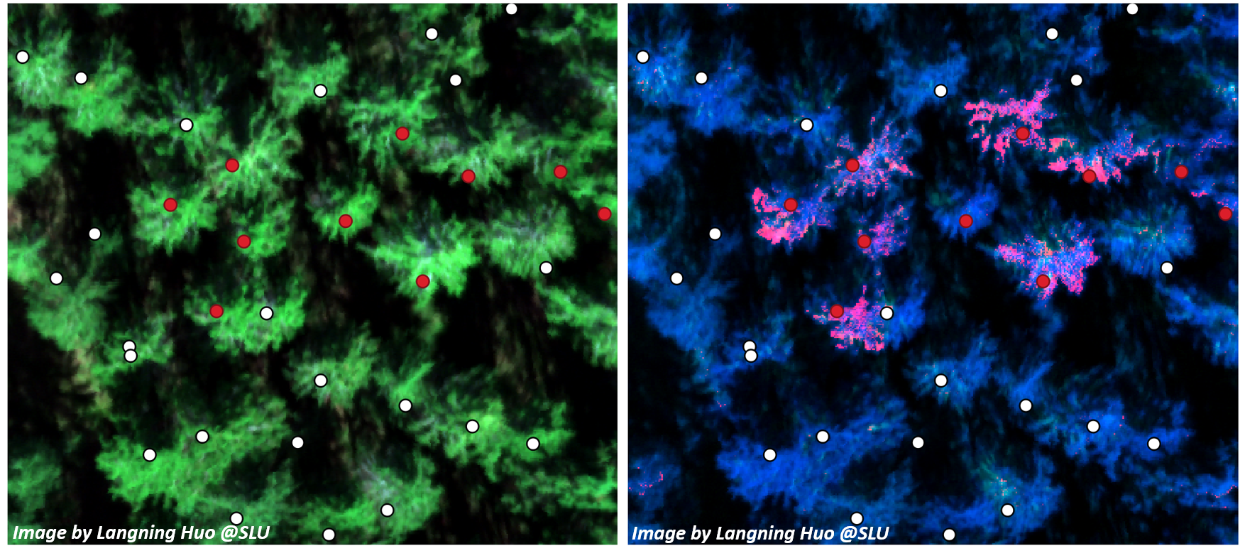
For the first time, researchers have detected spruce bark beetle infestations from the air at a very early stage, when the infestation has only affected one side of the tree trunk. The infestations are revealed by light reflections from the needles.The discovery opens up possibilities for more effective control of the bark beetle. ‒ Forest damage caused by the spruce bark beetle costs landowners millions of Swedish kronor, and it is difficult to detect outbreaks in time. However, our method has the potential to completely change that. We obtain such detailed information that it is possible to detect differences in health between branches on the same tree, says Langning Huo, researcher at the Forest Damage Centre at the Swedish University of Agricultural Sciences.
Picture: Langning Huo | Knowledge gaps about forest damage in Sweden
This report describes gaps in our knowledge regarding forest damage in Sweden. Such gaps limit our ability to predict the ecological, economic and social impact of damaging agents and factors, especially in a changing climate. Over the coming decades, the conditions for Swedish forestry are expected to change. This includes the structure and diversity of the forest, leading to uncertainty regarding risk from both biotic damaging agents and abiotic factors.
| | | | | |
New research project to strengthen preparedness for high-intensity forest fires
|
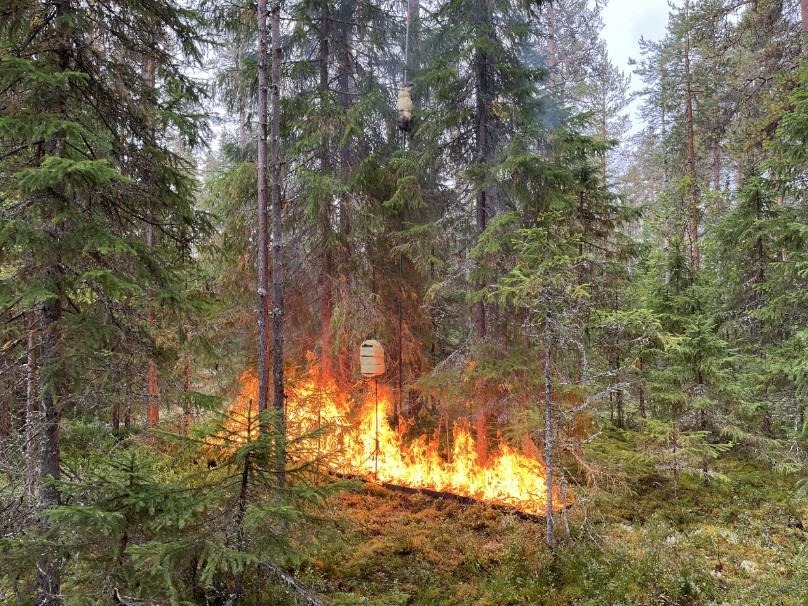
With an increased risk of forest fires that can reach the treetops and quickly spread over large areas, there is a need for a greater understanding of the conditions under which this occurs – and how we can reduce the risk of damage. In a new research project, SLU, in collaboration with RISE, is seeking answers to these questions in order to strengthen preparedness for future fires. Photo: Inka Bohlin |
| | You haven't forgotten to register for our annual meeting, have you? | The conference is primarily aimed at those working in the forestry sector, those who are professionally involved in or researching forests, and forest owners. Registration is open, on a first come, first served basis.
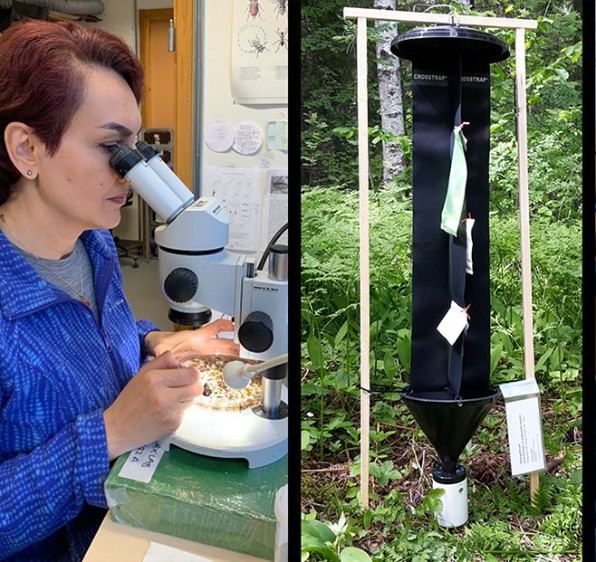
During the conference, participants will hear presentations on research projects in the field of forest damage, mingle and network, and contribute thoughts and ideas in two short workshops. | | | | | Scent traps can streamline the inventory of wood-boring beetles
Inventorying wood-boring beetles that live inside trees is a challenge. For the first time in Sweden – and also internationally – researchers have tested how effective scent traps are for this purpose. The results show that this is a promising method for the future. Photo: Torbjörn Esping. | | | |
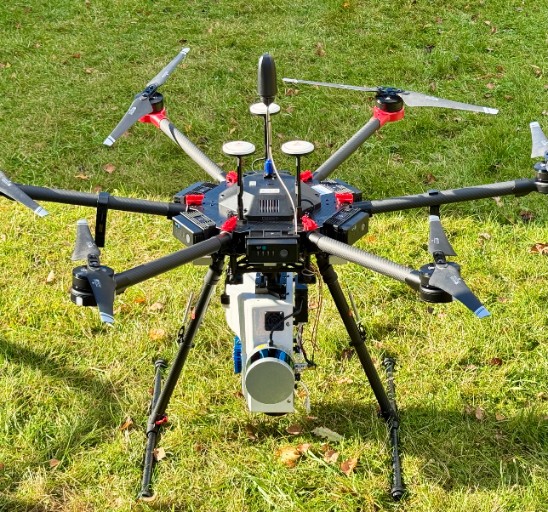
New hyperspectral drone pushes forest stress monitoring to a new frontier
SLU Forest Damage Centre has expanded its capabilities with Sweden’s first co-aligned VNIR–SWIR–LiDAR hyperspectral drone system for advanced forest stress detection. | | | | How moose choose to move in forest landscapes: ”Avoiding areas close to roads”
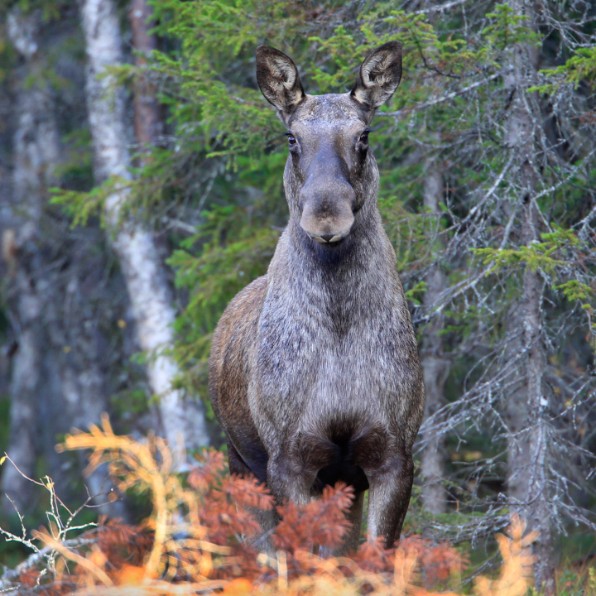
Most moose prefer to stay in young forests and mixed forests with a high proportion of deciduous trees. But they want to be far away from the nearest road. This is shown by a study from the Swedish University of Agricultural Sciences (SLU), which has mapped moose movements for over 20 years.
Photo: Jörgen Wiklund
| | | | | | CalendarVåra kommande event, seminarier och konferenser. |
SLU Forest Damage Centre and SLU's environmental monitoring and assessment Programme Forests invites you to a webinar presenting new research.
| | | | The meeting is aimed at doctoral students at SLU Forest Damage Centre's research school, supervisors of doctoral students at the research school, or external parties involved in the doctoral projects. | | | |
Konferensen vänder sig i första hand till dig inom skogssektorn, dig som är yrkesverksam inom eller som forskar om skog och dig som skogsägare. Anmälan är öppen, först till kvarn gäller.
| | | | | | Recently published
Finnish forest-related laws need to acknowledge climate change risks and integrate adaptive strategies to enhance resiliency Khanam, Tahamina; Peris-Llopis, Marina; Xu, Xiaoqian et al. [tom länk]Strong Changes in Soil Nutrient Stocks in Northern Forests Over Four Decades Spohn, Marie; Karltun, Erik; Stendahl, Johan European forests are under increasing pressure from global change-driven invasions and accelerating epidemics by insects and diseases Hartmann, Henrik; Battisti, Andrea; Brockerhoff, Eckehard G. et al. Temporal dynamics of airborne fungi in Swedish forest nurseries Larsson, Rebecca; Menkis, Audrius; Olson, Ake.
Identifying strategies to manage boreal forests: simulating moose and timber management scenarios at a landscape scale in the face of changing environmental conditions De Jager, Nathan R.; Neumann, Wiebke; Girona, Miguel M. et al.
| | | Do you follow our newsletter?
When you subscribe to the SLU Forest Damage Centre newsletter, you will receive updates and new findings about forest damage. Scan the QR code or click on the button below.
And don't forget to tell your colleagues or friends who own forests. | | | |
Our next newsletter will be sent out in February | |
|
|
|
|